

A clean window should not come with a difficult choice between appearance, access and convenience. When considering pure water versus traditional cleaning, the right method depends on the property, the condition of the windows and how the service will be managed over time.
For many homes and commercial properties across Leeds and West Yorkshire, pure-water cleaning is now the practical choice for regular external window cleaning. Traditional methods still have a place, particularly for certain ground-floor or internal jobs. The difference is not simply about equipment. It is about how safely and consistently windows, frames and sills can be maintained.
What is pure-water window cleaning?
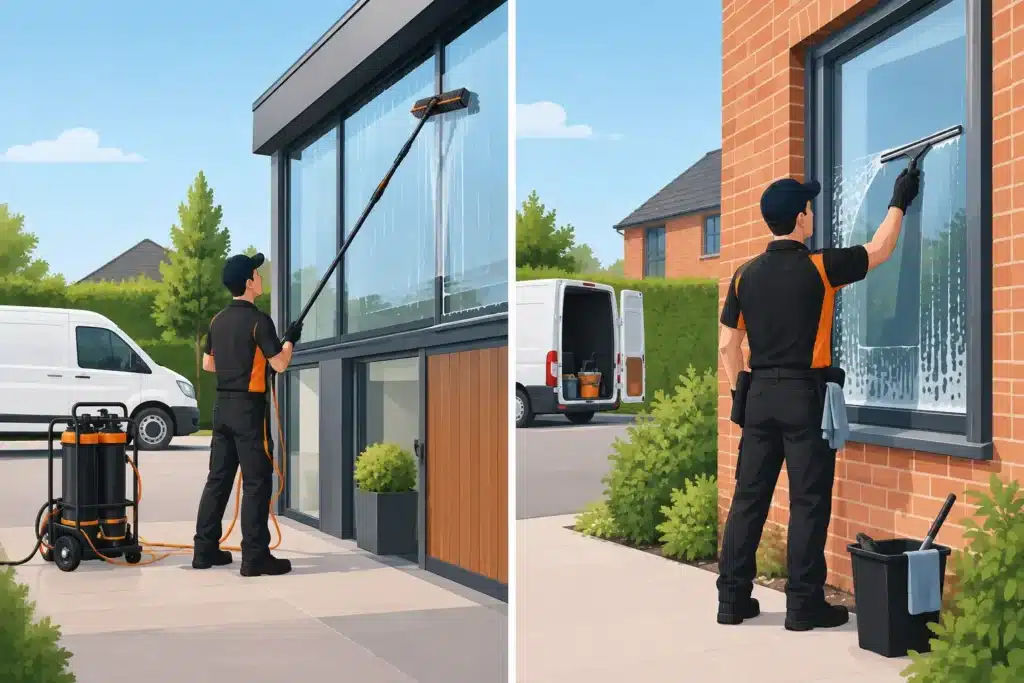
Pure-water cleaning uses filtered water that has had its natural minerals and impurities removed. The water is applied through a soft brush on the end of a water-fed pole. The brush loosens dirt from the glass, frames and sills, while a steady flow of pure water rinses it away.
Because the water contains no dissolved minerals, it can dry without leaving the spotting or residue associated with ordinary tap water. A professional cleaner will normally clean the glass as well as the surrounding frames and sills during a standard external visit, helping the whole window area look cared for rather than only the centre pane.
Water-fed poles allow the cleaner to work from ground level on many upper-floor windows, conservatories and awkward areas that would otherwise need ladder access. This makes the method particularly well suited to regular maintenance, where windows are cleaned on a planned schedule rather than left until dirt is heavily built up.
How traditional window cleaning works
Traditional cleaning usually involves a bucket of cleaning solution, an applicator and a squeegee. The cleaner washes the glass, then removes the water by hand with the squeegee blade. Done well, it is a skilled method capable of leaving a clear finish.
It is often useful for accessible ground-floor windows, internal glass and detailed areas where close handwork is needed. However, reaching higher windows traditionally can involve ladders or other access arrangements. That can take longer, create practical restrictions around the property and may not be the most suitable approach for every regular clean.
Traditional cleaning also tends to focus primarily on the glass. Frames and sills can be cleaned, but this should be agreed as part of the service rather than assumed. Dirt on the surrounding uPVC, painted timber or aluminium can quickly affect the overall appearance of otherwise clean glass.
Pure water versus traditional cleaning: the key differences
The most noticeable difference is the method of access. Pure-water systems allow many windows to be cleaned from the ground using a pole, while traditional work may require the cleaner to be close enough to use a squeegee by hand. For upper floors, extensions, windows above conservatories and hard-to-reach elevations, that distinction matters.
There is also a difference in what is cleaned as part of the process. Pure-water cleaning naturally covers the glass, frames and sills because the brush passes across the whole area. This is helpful on regular visits, especially where road dust, pollen, cobwebs and weather marks collect around window edges.
The finish develops in a slightly different way too. A traditionally cleaned window is dried with a squeegee before the cleaner moves on. With pure water, the window is rinsed and allowed to dry naturally. On a first clean, very dirty frames may release old residue after the visit, and the result can improve over the next one or two regular cleans as the build-up is removed.
For most routine external cleaning, pure water offers a reliable balance of reach, safety and consistent coverage. That does not make traditional cleaning unsuitable. It simply means the best option should be chosen for the building and the job, rather than following one approach for every property.
Does pure water leave windows spotless?
When the water is properly purified and the window has been thoroughly rinsed, it should dry clear. The principle is straightforward: without minerals in the rinse water, there is nothing left behind to form water spots as it evaporates.
There are situations where results need a little patience. Windows that have not been cleaned for some time can hold dirt in the seals, vents and frame edges. Rain can wash some of that loosened dirt onto the glass after the first clean. Older frames, damaged seals and staining caused by other sources can also affect the appearance independently of the cleaning method.
A regular schedule makes a real difference. Once windows, frames and sills are maintained routinely, there is less embedded grime to shift at each visit and the finish is generally more consistent. This is one reason recurring cleaning is often simpler than arranging a one-off clean only when the windows become noticeably dirty.
Is rain a problem after window cleaning?
Rainwater is not the same as hard tap water. By itself, rain does not normally create the white spotting associated with mineral deposits. What can affect a freshly cleaned window is dirt already sitting on frames, ledges, brickwork or roofline details, which may be carried onto the glass by heavy rain.
That is more likely after a first clean or where a property has accumulated a lot of debris. Cleaning frames and sills alongside the glass helps reduce this over time. There is rarely a practical benefit in delaying a planned clean simply because rain is forecast, particularly in West Yorkshire where waiting for a completely dry outlook could mean waiting a while.
Safety and access at your property
Window cleaning involves working around cars, paths, gates, garden furniture and sometimes narrow side access. A professional approach is not just about arriving with the right tools. It means assessing how the property can be cleaned sensibly, communicating where access is needed and using a method appropriate to the windows.
For many external windows, water-fed poles reduce the need to work at height on ladders. They can also reach over conservatories, garages and planted borders where ladder placement would be difficult or could risk damage. There will still be properties and individual windows where access, surface condition or layout needs to be considered carefully.
For commercial premises, the benefit is often continuity. Offices, shops, schools and managed properties need a cleaning method that can be carried out with minimal disruption and repeated to a clear standard. Planned visits and clear communication reduce the need for site staff or managers to keep chasing arrangements.
Convenience matters as much as the cleaning method
A well-cleaned window is only part of a good service. Homeowners should not have to remember when their last clean took place, wait around without knowing whether someone is coming, or search for cash on the day.
A reliable recurring service gives customers advance notification, a regular visit pattern and straightforward cashless payment. It turns window cleaning into a managed routine rather than another household task to organise. The same applies to landlords, managing agents and business owners who need premises maintained without repeated follow-up.
At Morrells Window Cleaning, pure-water systems are used to clean external windows, frames and sills as part of a scheduled service. The focus is simple: clear communication, dependable visits and a clean property without unnecessary hassle.
Which option is right for your windows?
Pure-water cleaning is often the strongest choice for regular external cleaning, particularly where upper-storey windows, conservatories or difficult access are involved. It is designed for thorough coverage of glass, frames and sills, with the practical advantage of working from ground level in many situations.
Traditional cleaning can still be appropriate for accessible windows, certain detailed work and internal glass. A professional cleaner should be able to explain which method suits the job and set clear expectations, especially if the property has not been cleaned recently.
The most useful question is not whether one method is always better than the other. It is whether the service will keep your particular property looking well maintained, safely and consistently, without adding another job to your list. Set up the right schedule once, and clean windows become one less thing to think about.